Reflections on Creative Brain Week 2026 in Dublin
Thinking about the senses, creativity and human wellbeing - particularly brain health through smell, sound, embodied experiences and the visual arts. Plus some thoughts around research approaches.

I’ve recently been reading around our experience of our senses and found that it’s a great deal more complicated than the five senses we commonly think of - sound, sight, smell, touch and taste. Actually a lot of people have wide ranging opinions on exactly how many senses we have, which largely depends on what ‘sense’ means and also exactly how you want to subdivide each category. One way of dividing these senses, or sensory modalities, up is into nine categories1:
Seeing - visual system
Hearing - auditory system
Balance - vestibular system
Touch - somatosensory system
Body position - proprioception
Body movement - kinesthesis
Pain - nociception
Smell - olfaction
Taste - gustation
So you can see that there are four more ‘invisible’ senses here that also relate to our sense of our bodies in our environment, as well as the experience of pain. These senses combine to give us our unique experience of the world, as our brains take the signals from different receptors, and turn these signals into some sort of meaning or perception. For example, our photoreceptors enable us to perceive colour. But of course these never exist in isolation, our senses are all collaborating together to help us make sense of the world around us.
This more scientific understanding of our senses naturally ties in with our human capacity for creativity, an area being explored under the banner of neauroaesthetics and neuroarts. If you’ve not read ‘Your Brain on Art’ by Ivy Ross and Susan Magsamen you should - it will make you want to make more space for creativity in your life! You don’t have to be an artist, it’s just good for you! And an encouragement to try and find space for doing printmaking again for myself.
More recently this has further developed into neauroarchitecture, which more directly links with my PhD work. How do the environments we live in impact our wellbeing? How can they be shaped to better help us to flourish?
Anyway when I came across the Creative Brain Week, exploring creativity and brain health, with a focus on some of these senses I thought it would be fascinating to go along! So here are some of the main things I took away from it, both about the senses and about approaches to research.
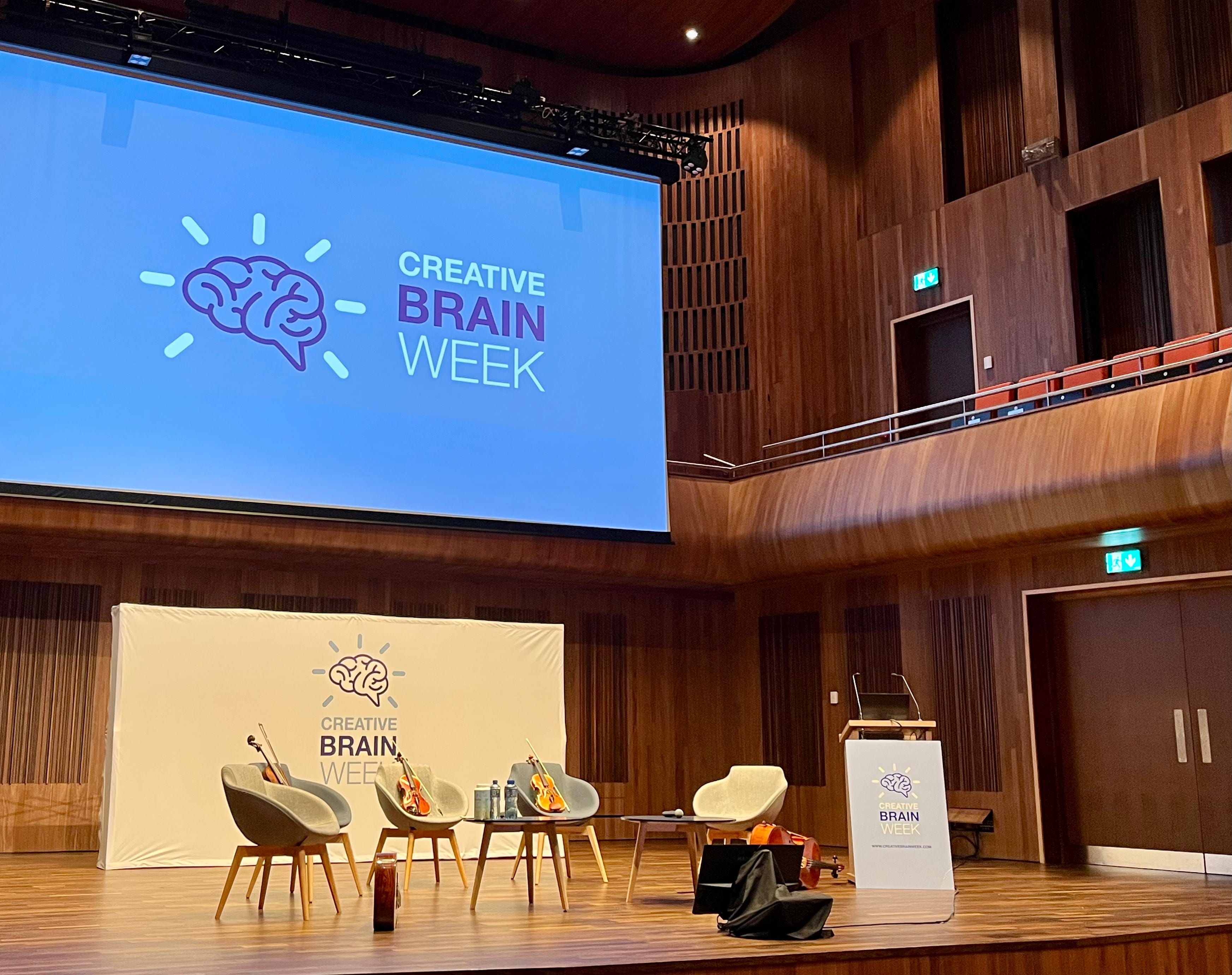
Inside the Royal Irish Academy of Music - with amazing acoustics!
Smell
I loved the juxtaposition of having a master of wine speaking straight after a researcher into our olfactory systems, which is one of our more ancient senses. Our sense of smell is tied in closely to our memories and emotions - have you ever experienced being transported back to a particular moment or place through a scent?
Our sense of smell is also inherently connected to our breathing. Paul Dockree and Mani Ramuswami shared about how our breath cycle affects other elements; breathing helps regulate attention and this varies across the breathing cycle, breathing through the nose (not mouth) synchronizes with brain activity, mid-inhalation we’re more likely to see things in our peripheral vision.
Our sense of smell can also be honed, as one study showed that the brains of wine experts have a higher level of smell discrimination (ie being able to tell different smells apart) over time. Given that it takes seven years to become a master of wine, this clearly takes some practice! Yet it’s possible to tell the origin, variety, age, quality and more about a wine through your nose. Isn’t it great that we can actually improve our sensory discrimination rather than everything necessarily diminishing over time as we age?
There are also negative ways that we use smell, for example to stigmatise. One researcher, Pradeep Narayanan, shared about how smell can become attached to the identity of a community over time, due to occupation and geography, to describe certain castes in India. His work involves using participatory practices to break down stigma and build empathy across communities - more on that later.

Sound
Like smell, sound (and in particular music) engages the parts of our brains that connect with emotion, memory and attention. Spending time listening to music is really important for our brains, as is the opportunity to choose what music we listen to. One study by Claire Howlin showed how having choice over music we listen to actually helped to reduce the experience of pain.
Given how important our sense of hearing is, hearing loss (you can get an idea what that feels like here) is something we should try to prevent and also work with to enable more people to hear music in some way. Success in addressing hearing loss doesn’t just mean being able to hear speech, but being able to hear music and other sounds that we rely on for e.g. confidence in way finding. Sadly hearing loss affects 25% of those over 60 and is linked to dementia, which could be due to cognitive load, sensory deprivation or social isolation; this is one of the most important factors to address in reducing the development of dementia in the population. Tinnitus affects 10-15% of the population. Tinnitus disproportionately affects musicians (30-40%) which varies dependent on orchestra position as well as stress. (Note: I’m not sure which countries these studies focused on for these figures - sorry!)
Given the value of music, a creative opportunity exists for people to develop music design for people with implants and hearing aids, which has been under explored. The experience of music would be different but valuable in continuing to connect with emotions, memory and other parts of our brains.
I was reminded of another talk I attended last year at University of Leeds on Aural Diversity by Andrew Hugill. He also highlighted the importance of recognizing that everyone hears in a unique way; our ears (pinna) are all as unique as our fingerprints, and about five out of six of us experience “normal” hearing. Which means one in six experience a medically recognized hearing difference. This can include a greater level of hearing as well as hearing loss, for example with autism. They developed an aural diversity toolkit for designers and created some really interesting musical projects that engage with other elements of our sensory experience of music alongside our sense of hearing, in collaboration with musicians who experience hearing difference, something that can still be stigmatized in the music world.

Embodied experiences
The idea of embodied experiences came through repeatedly, in the use of participatory practices, in our own engagement as an audience with music and theatre, with body movements (something that can only be experienced in person), with not checking email during the talks because our own movements impact those around us. We can enable others through our own body movements, projecting different emotions, as our visual systems pick these cues up from each other. We don’t just communicate with our words. We can make music with our bodies, with the objects around us, and it doesn’t even need to be with specialist equipment; one community project involved making music with old water carriers and some gongs that were lying around picking up dust. These experiences are relational, provide collaboration, and can give space to others.

Visual arts
Sheena Barrett, head of research and learning at IMMA considered what happens when we make art. We make decisions, experiment, learn, build curiosity, fail and keep going, build resilience and adaptation, play, connect to ourselves, create an aesthetic mindset, build meaning and a sense of purpose. And when we experience art together this builds social connections, decreases loneliness, we learn to listen and express ourselves, we build curiosity, meaning and stories together, build attentiveness, sit with time in a different way, learn what can calm us and keep us in a moment that isn’t a constant sense of emergency, and help us to rehearse an imagined future. All good stuff, right!

A large theme from the day in IMMA was also about the role of cultural spaces. A question they asked was “who is missing from the room?” Historically and still today art galleries have a very narrow group of people who access these spaces (aka people like me). One area that is perhaps changing this is social prescribing, which as the name suggests involves prescribing social alongside or instead of medical prescriptions as a way of improving wellness. For example this could encourage access to museums and galleries for art psychotherapy, yoga, mindfulness, sound baths, with the hope that the museum moves towards being a non-clinical, non-stigmatising safe space.

This somewhat shifts the emphasis of what a museum is, providing an opportunity for the museum to be a place of care (you can listen to one of their talks on this here). In fact one museum, ICOM, in 2022 rewrote their definition of the purpose of a museum as an “institution in the service of society”, wanting the museum to be a place where people gather and know together rather than as a place where the museum has already figured everything out and is merely informing the visitor. The museum is moving from:
vertical to horizontal
exclusive to inclusive
standardized to polyphonic
pedagogic to experiential
in-person to multi platform
high temple to third space
self-enclosed monolith to interwoven campus
spectacle to sanctuary
indoor to outdoor
editing to engaging
A focus within this was the role of third spaces and practicing ‘radical hospitality’. These are spaces that are not home or work, but instead somewhere else where people can gather, which can be really important for a sense of community, safety, rest and so on. For example, cafes, pubs, churches, libraries. The move to make spaces, and particularly free spaces like this art gallery, more welcoming is definitely positive. It reminded me of a project I worked on whilst at Aalto University in collaboration with the Espoo libraries in Finland; similarly they had moved from an older definition of a library as a silent place towards a community hub, a third space, where anyone was welcome - which also comes with its own challenges, but is an amazing thing to be reaching towards. If you’ve never visited a Finnish library you absolutely should - Oodi, the Helsinki central library will completely reshape what you ever thought possible for a library space to be. (I’m sure when people visited me there, and I said we must go to the library, pictured below, they will have thought that was pretty strange!)


Research approaches
Interdisciplinary approaches
Perhaps the thing that stood out to me most about the conference was the juxtaposition of people from a wide range of disciplines, particularly art and science, which together created a really engaging conversation that did not completely rely on listening to lectures but was also embedded with doing something, such as being an ‘audience orchestra’, doing some collective breathing exercises or taking part in a slow art workshop. The listening experiences (sometimes) also encompassed more than one sense, the most stand out one being a performance by some of the students at the Royal Irish Academy of Music called “What does your soul sound like?”, which combined music with five spoken languages alongside visual slides, each section reflecting the experiences of home of the musicians.
I also loved the work by musician Helen Anahita Wilson, who has both created some very cool biophilic soundscapes (ie music from nature) and successfully bridged quantitative and qualitative research through her work. She also created some music “KRANKENHAUSFUNK and the extrinsic death receptor pathway” (yes really!) out of rewired chemotherapy infusion pumps, which came from her own experience of battling cancer.
Claire Howlin’s investigation into music as part of the music cognition lab engaged both scientific lab experiments alongside the use of photovoice to effectively capture the experiences of neurodivergent people from their own perspectives. She found that a part of forming our sense of social identity is being able to share things like the music we like with others, and this is something that a wide range of people can engage with.
A final thought provoking piece of interdisciplinary work was the Navigator Project by Fishamble. They observed that often research starts with the science and ends with the arts, ie someone conducts some scientific research and then artists/designers are brought in to visualize and communicate these findings more effectively. With the Navigator Project, this was flipped around, starting with artistic enquiry. They invited people to submit plays about health inequality in Ireland, selected ten of these for publication/performance, and then invited healthcare professionals to respond to the artwork by writing essays. This cast a different perspective on how health inequalities were perceived.
The value of art and intuition
Although the science does help us to understand the impact of the arts on our brains and has great value, art doesn’t always need to be scientifically analysed but instead is something to be enjoyed that has value in itself. This was mentioned by Louise Foott, who also introduced us to the only more recently discovered organ called the interstitium as a symbol for something in the in-between space. Notably it required a different form of knowledge to dissection to identify it and in a similar way we should not value one form of knowledge over another.
This idea of different forms of knowledge was also brought up by Nicholas Johnson who talked about performative knowledge, which is knowing in your body that something is happening or changing. He said that the most dominant forms of knowledge are Episteme (axiom-based knowledge) and Techno (craft, material, technology, with subordinate forms of knowledge as Phronesis (street-based knowledge) and Sophia (spiritual depth, wisdom), and finally at the bottom of the pile nous (intuition or sensing). It is interesting to consider this hierarchy of what is deemed to be the most important and in what way it might be possible to better value this fuller spectrum of knowledge.
Beyond the visual
Increasingly, funding is available for projects that are reflecting a broader engagement with the non-visual senses, such as sound and smell, as ‘the visual bias’ is recognised. Its understandable that we would often prioritise considering the visual appearance over other aspects of the arts and our environments, given that visuals play a large role in our perception. But as we’ve seen other senses are also key for us making sense of the world around us, and connect deeply with our memories, emotions, and attention - among many other things.
Participatory Practices
Pradeep Narayanan talked about participatory practices, which means engaging with people in a non-hierarchical and inclusive way. He noted that participation is often designed for those who require the least adjustment. One way they had engaged with this community was undertaking a transect walk, which is walking with someone through an area and seeing it more through their eyes - observe, notice inequalities, notice the smells - food, stagnant water, anything else. This enables connection to a different sensory world inviting empathy and imagination between people. They also explored touch as a way of bridging communication between people were there was no other shared medium, and found that this was a way of building solidarity.
The closest thing I’ve experienced to this was working on a project designing products for people with visual impairments; one day I walked around the city centre with someone who has been blind for 20 years. It was amazing to see how she navigated through her other senses, as well as with the aid of a guide dog. She knew our location because of the smells and sounds around us, particularly the strong smell of coffee from a cafe and other signals. She had the whole city mapped out in her head; so you can imagine the impact it has when shops change, and even when shop interiors move around (think supermarkets) and how this impacts independence and confidence.
Rest, creativity and wellness
“Rest as resistance” was mentioned. I’m afraid I didn’t note the context, but perhaps this was relating to pushing back against the need for constant output and productivity. Instead, the brain needs space for creativity to thrive. Someone else commented on the importance of “not being on all the time”. One session by Oonagh O’Brien, a cyberpsychology researcher, was about digital wellness. and in her research she found that only 5% of wifi used at uni was for educational purposes. 54% of students felt they had a smartphone addiction, 70% felt lonely, and 40% felt their wellness was below what it should be. I know the challenges of “switching off” from the internet; I, probably like you, have experienced this first hand. As well as negatively impacting our creativity, it seems that unhealthy internet usage can rob us of our sense of community, our ability to learn, and our health. Her course on digital wellness has had a positive impact on the students on her campus, and is surely something we all need to consider.
Finally…
There were a number of key words that came up over the week, and I think are great things for us to pursue in work, home and in third spaces! These included creating space for vulnerability, joy, humility, curiosity, community, collaboration, creativity and relationality.
Wouldn’t the world be a better place if we made more space for this in our lives?

Yellow is commonly associated with happiness!
Mather, George. 2023. Foundations of Sensation and Perception. Fourth edition. Routledge, Taylor & Francis Group.